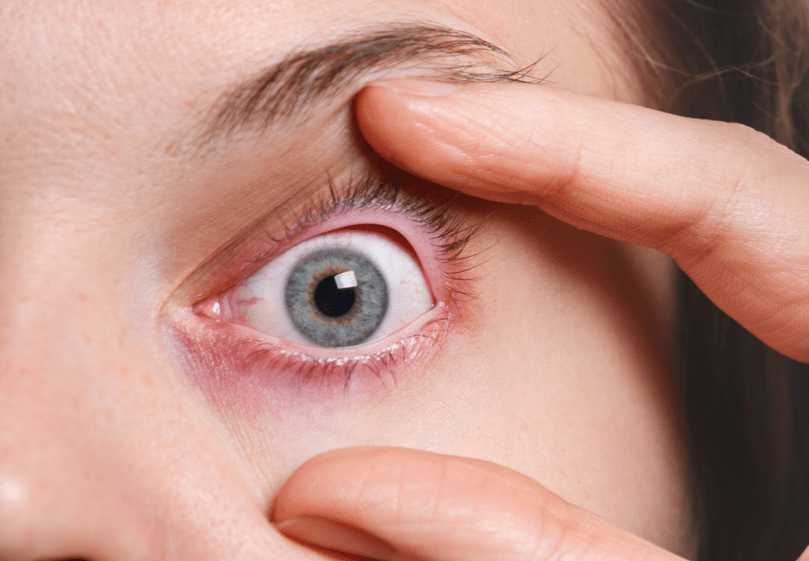
Blepharitis is one of the most common causes of red, itchy, burning eyes – and one of the most underdiagnosed. It is a chronic inflammation of the eyelid margins, where the lashes grow and the eye’s oil glands open. In most cases it does not threaten vision, but it is wearing, it keeps coming back, and it often lies behind dry eyes, recurrent styes and contact lens discomfort. The good news: once you understand what is driving it, it can be controlled well.
What is blepharitis
The eyelid margin is a small but busy area: the lashes and their follicles, small oil glands, and on the inner edge – the openings of the meibomian glands, which produce the oily layer of the tear film. In blepharitis, this area is in a state of ongoing inflammation. There are two main forms, and they usually appear together:
Anterior blepharitis – at the base of the lashes. Flakes, crusts or “sleeves” form around the lashes, and the eyelid margins are red. It is linked to bacteria that live on the skin (mainly staphylococci), to seborrhea of the skin and scalp, and in many cases to Demodex mites.
Posterior blepharitis – on the inner edge of the eyelid; it is essentially an expression of meibomian gland dysfunction. The glands become blocked, the oil they secrete thickens, and the tears evaporate too quickly – leading to dryness, burning and fluctuating blurred vision.
Symptoms
- Redness and swelling of the eyelid margins.
- Itching, burning and a gritty, sandy feeling in the eyes.
- Flakes or crusts on the lashes, especially in the morning.
- Watery eyes – or, on the contrary, dry eyes – and blurred vision that improves with blinking.
- Sensitivity to light and discomfort with contact lenses.
- In long-standing cases: loss of lashes, lashes growing toward the eye, and recurrent styes or chalazia.
Symptoms are usually worse in the morning and vary from day to day. They tend to get worse with air conditioning, screen use, smoking and exposure to dust.
What causes blepharitis
- Demodex mites – tiny mites that live in the lash follicles. Many people carry them without any symptoms, but when they multiply they cause inflammation and characteristic flakes at the base of the lashes.
- Blocked meibomian glands – very common with age, in rosacea and with prolonged screen use.
- Skin conditions – seborrhea (dandruff on the scalp and eyebrows) and rosacea, which often involves the eyes as well.
- Bacteria from the skin, and sensitivity reactions to makeup or products used around the eyes.
Blepharitis is closely linked to dry eye – often it is the same problem seen from two directions, which is why the two are treated together.
How it is diagnosed
The diagnosis is made with a slit-lamp examination: the doctor examines the eyelid margins and the base of the lashes, checks whether the meibomian gland openings are blocked and the quality of their secretions, and assesses the tear film and the surface of the cornea. Cylindrical flakes around the lashes strongly suggest Demodex. It is also important to rule out other conditions that can look similar.
Treatment
The foundation: regular eyelid hygiene
This is the most important part, and it is done at home:
- Warmth – a warm compress over the closed eyes for a few minutes, to soften the oil in the glands and the crusts on the lashes.
- Massage – gentle pressure and massage of the eyelid margins toward the lashes, to help the glands empty.
- Cleaning – wiping the base of the lashes with an eyelid-cleaning wipe or solution.
Once or twice a day, every day. Improvement comes gradually, over weeks – and stopping too early is the most common reason for a flare-up.
Lubricating drops
Lubricating eye drops, preferably preservative-free, relieve the dryness and burning that accompany blepharitis.
Medical treatment
When hygiene alone is not enough, the ophthalmologist can add, as needed:
- Antibiotic ointment or drops on the eyelid margins, for a limited period.
- Anti-inflammatory drops for a short period, during a significant flare-up and under follow-up.
- Oral treatment with low-dose medications from the tetracycline family, mainly when there is significant gland blockage or rosacea.
- Dedicated Demodex treatment – products based on tea tree oil or ivermectin, and in recent years also drops developed specifically against the mite.
In-clinic treatments
For stubborn cases, there are treatments aimed at opening the meibomian glands and reducing inflammation: IPL treatment (intense pulsed light), heat-and-pulsation treatments that empty the glands, and mechanical cleaning of the eyelid margins in the clinic.
When to get checked
If your eyes are red, itchy or burning over a long period, if there are flakes on your lashes, recurrent styes, or if the home routine is not enough after several weeks – it is worth getting checked. Real pain, marked sensitivity to light or reduced vision are not typical of simple blepharitis and require prompt examination. Prof. Michael Mimouni is a specialist in the cornea and ocular surface; at the examination we will identify what is driving the inflammation – Demodex, the glands, the skin or a combination – and build a treatment plan that suits you. Contact us to schedule an examination.
The information on this page is general and is not a substitute for an examination and personal medical advice. Diagnosis and treatment decisions are made only after a complete eye examination.
Frequently asked questions
Does blepharitis ever go away completely?
Usually not completely – it is a chronic tendency of the eyelid margins. But with a regular eyelid hygiene routine and treatment of the underlying cause (Demodex, meibomian glands, skin), most patients achieve good control with very few symptoms. Flare-ups come back mainly when the routine is stopped.
Is blepharitis contagious?
No. Blepharitis is not an infection that passes from person to person. Even when bacteria or Demodex mites are involved, these are found on most people's skin, and the problem is the eyelid's inflammatory reaction to them.
How do I clean my eyelids if I have blepharitis?
Place a warm compress over your closed eyes for a few minutes, gently massage the eyelid margins, and then wipe the base of the lashes with an eyelid-cleaning wipe or solution. Do this once or twice a day, every day – even when the symptoms settle down.
When is treatment beyond hygiene needed?
When symptoms persist despite a consistent routine for several weeks, when there are recurrent styes, damage to the cornea, or signs of Demodex. In these cases the ophthalmologist can add drops or ointments, a dedicated Demodex treatment, oral treatment, or in-clinic treatments such as IPL.