If you are reading this, you probably know the feeling well: burning that starts in the afternoon, eyes that turn red and tired in front of a screen, a gritty sensation that does not go away even after drops. Perhaps you have already tried artificial tears — maybe several kinds — and they help for an hour or two before everything comes back. It is frustrating, and it is understandable, because in most cases drops soothe the symptom but do not touch the root of the problem.
This is where IPL treatment comes in. It is one of the most significant treatments to have emerged in recent years for dry eyes, especially for people for whom the usual treatments were not enough. On this page I will explain exactly how the treatment works, who it suits and who it suits less, how many sessions are needed, and what the research shows about the chances of success — with no marketing promises and no fine print.
Why Drops Are Not Always Enough
Most people think of dry eye as a problem of “too few tears.” In reality, in most cases — by some estimates, over 80% of dry eye cases — the problem is not the quantity of tears but their quality. This is a fundamental distinction, because it completely changes what the correct treatment is.
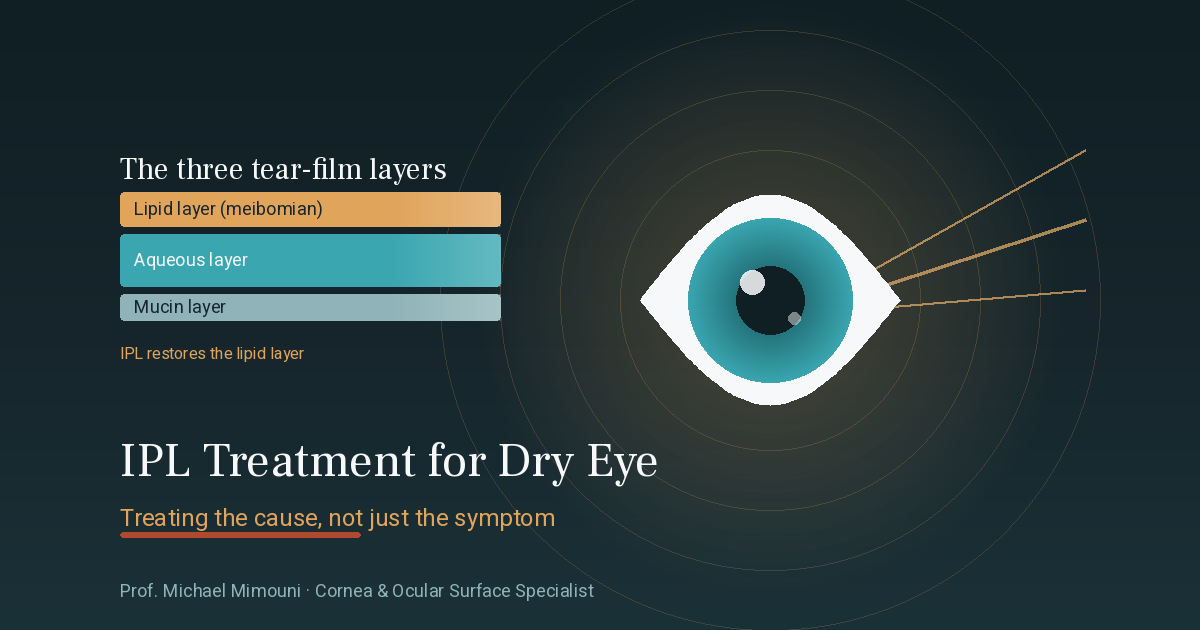
Your tear film is not just water. It is built from three layers, and its outer layer is made of a thin film of oil. This oil is produced by tiny glands that sit within the eyelids — the meibomian glands. Its role is to keep the tear from evaporating too quickly. When these glands become blocked or stop functioning properly — a condition called meibomian gland dysfunction (MGD) — the oil layer becomes thin or absent, the tear evaporates within seconds, and the eye feels dry even if it produces a perfectly normal quantity of tears.
That is why artificial tears soothe but do not solve: you are adding more “water” to the eye, but the layer meant to protect it is still missing. And that is precisely where IPL works differently from any other treatment.
What IPL Is and How It Treats Dryness
IPL stands for Intense Pulsed Light. The technology itself has been familiar for years from dermatology, and over the past decade it has been adapted and extensively studied for treating dry eye caused by MGD.
In practice, the treatment is a series of focused light pulses directed at the skin around the eyes — over the cheekbone, below the lower eyelid, and at the temples — and not into the eye itself. These pulses have several effects that work together:
Warming and opening the glands. The heat the pulses generate melts the thickened oil blocking the meibomian glands, allowing them to resume secreting normal oil. Usually, immediately after the pulses I perform expression (controlled massage) of the glands to drain the content that has been released — an important step that increases the effectiveness of the treatment.
Reducing inflammation. The pulses close superficial, tiny blood vessels around the eyelids that feed a chronic inflammatory process. Reducing this inflammation improves gland function over time.
Treating Demodex. Demodex is a microscopic mite that sometimes resides at the base of the eyelashes and worsens eyelid inflammation and dryness. The IPL light damages the mite and reduces its presence.
The result is not a “replacement” of the tears but a restoration of the natural mechanism that produces the oil layer — that is, treating the root, not the symptom.
What a Treatment Actually Looks Like
The treatment is performed in the clinic and lasts about 15 to 20 minutes. Before the pulses, a clear gel is applied to the skin and a small shield is placed over the eyes. During the pulses you feel a mild sensation of warmth or a gentle “snap” — most patients describe it as slightly unpleasant but not painful. No anaesthesia is needed, and immediately afterwards you can return to your full routine: driving, going back to work, wearing makeup the next day.
A series of three to four sessions is usually needed, spaced about three to four weeks apart. The reason is that the meibomian glands recover gradually — a single session provides a week or two of temporary relief, but it is the full series that brings improvement lasting for months. For some patients a single maintenance session every six to twelve months is recommended to preserve the result.
What Are the Chances It Will Help — What We Actually Know
Here it is important to me to be precise, because this field has no shortage of exaggerated promises. Studies on IPL for dryness caused by MGD consistently show improvement in most patients — both in the symptoms they report (burning, gritty sensation, redness) and in the objective measures we assess in the clinic, such as tear evaporation time and the quality of gland secretion.
But — and I say this to every patient before we begin — IPL does not “cure” dryness and does not eliminate it forever. The realistic goal is a significant and durable improvement in quality of life: less dependence on drops, less discomfort throughout the day, and the ability to return to activities the dryness interfered with. In some patients the improvement is dramatic; in others it is partial and requires combining it with additional treatments. Being honest about expectations is part of good care.
Who IPL Suits — and Who It Suits Less
The treatment is especially suitable for:
- People with dry eye caused by meibomian gland dysfunction (MGD) — which, as noted, is most cases
- Those for whom artificial tears and conservative treatments were not enough
- Patients with chronic inflammation of the eyelid margin (blepharitis) or the presence of Demodex
- People who suffer from chronic dryness and are looking for a solution that addresses the root of the problem rather than just soothing it
The treatment is less suitable, or requires careful consideration, for people with very dark skin tones (because of the way the skin absorbs the light), pregnant women, people with certain light sensitivities or active skin conditions in the treatment area, and those whose dryness stems from an entirely different cause — for example, reduced tear production due to an autoimmune disease. For exactly this reason, the treatment never begins with the first pulse but with a diagnosis.
Why Diagnosis Comes Before Treatment
Dry eye is not a single diagnosis — it is a spectrum of different conditions with different causes, and each calls for a different treatment. IPL is an excellent tool for MGD, but it is not the right tool for every kind of dryness. So before recommending a treatment, I perform an evaluation of the ocular surface: examining the meibomian glands and the quality of their secretion, measuring the stability of the tear film, assessing the degree of inflammation, and checking the eyelid margins and lashes.
Only once we understand exactly what is causing your dryness can we build the right treatment plan — one that sometimes includes IPL alone, and sometimes combines it with complementary treatments such as high-quality artificial tears, eyelid-margin care, or supplements. This approach — treatment tailored to the individual cause, rather than a one-size-fits-all solution — is what distinguishes temporary improvement from real improvement.
When to See a Specialist Ophthalmologist
Mild, occasional dryness is common and can usually be managed with artificial tears and good habits. But it is worth seeing a cornea and ocular-surface specialist for an evaluation if:
- The symptoms persist beyond a few weeks and interfere with your daily life
- Artificial tears no longer provide an adequate response
- There is redness, burning, or a persistent gritty sensation
- The dryness is accompanied by blurred vision that improves after blinking
- You wear contact lenses and have become unable to tolerate them as you once could
Untreated chronic dryness is not merely a discomfort — over time it can damage the ocular surface and the cornea. The earlier it is diagnosed and treated, the more effective the treatment and the better the outcome. I carry out these evaluations and treatments, including IPL, at my Haifa clinic, serving patients across northern Israel.
If you suffer from persistent dryness and would like to find out whether IPL — or another treatment — suits your specific situation, you are welcome to get in touch and schedule an evaluation at my Haifa clinic. We will start with an accurate diagnosis, and from there build the right treatment plan for you together.
Frequently Asked Questions
Is IPL treatment for dry eye painful? No. Most patients describe a mild sensation of warmth or a gentle snap during the pulses, but not pain. No anaesthesia is needed, and the session lasts about 15 to 20 minutes. You can return to your full routine immediately afterwards.
How many IPL sessions are needed to see improvement? Usually a series of three to four sessions, spaced three to four weeks apart. A single session gives temporary relief, but it is the full series that produces improvement lasting for months. A maintenance session every six to twelve months is sometimes recommended.
Does IPL cure dry eye permanently? No. IPL significantly improves symptoms and meibomian gland function, but it does not eliminate the tendency toward dryness for good. The goal is a durable improvement in quality of life and reduced dependence on drops, and periodic maintenance treatment is sometimes required.
Who is IPL treatment suitable for? It is especially suitable for people with dry eye caused by meibomian gland dysfunction (MGD), those for whom artificial tears were not enough, and those with chronic eyelid inflammation or Demodex. It is less suitable for people with very dark skin tones, pregnant women, and when the dryness stems from a different cause. A prior evaluation determines suitability.
Is a diagnosis needed before IPL treatment? Yes, absolutely. Dry eye arises from various causes, and IPL is mainly suited to dryness caused by MGD. An assessment of the ocular surface and meibomian glands is what determines whether IPL is the right treatment for you, or whether a different or combined treatment is needed.
Frequently asked questions
Is IPL treatment for dry eye painful?
No. Most patients describe a mild sensation of warmth or a gentle snap during the pulses, but not pain. No anaesthesia is needed, and the session lasts about 15 to 20 minutes. You can return to your full routine immediately afterwards.
How many IPL sessions are needed to see improvement?
Usually a series of three to four sessions, spaced three to four weeks apart. A single session gives temporary relief, but it is the full series that produces improvement lasting for months. A maintenance session every six to twelve months is sometimes recommended.
Does IPL cure dry eye permanently?
No. IPL significantly improves symptoms and meibomian gland function, but it does not eliminate the tendency toward dryness for good. The goal is a durable improvement in quality of life and reduced dependence on drops, and periodic maintenance treatment is sometimes required.
Who is IPL treatment suitable for?
It is especially suitable for people with dry eye caused by meibomian gland dysfunction (MGD), those for whom artificial tears were not enough, and those with chronic eyelid inflammation or Demodex. It is less suitable for people with very dark skin tones, pregnant women, and when the dryness stems from a different cause. A prior evaluation determines suitability.
Is a diagnosis needed before IPL treatment?
Yes, absolutely. Dry eye arises from various causes, and IPL is mainly suited to dryness caused by MGD. An assessment of the ocular surface and meibomian glands is what determines whether IPL is the right treatment for you, or whether a different or combined treatment is needed.