Dry eye is one of the most common phenomena after laser vision correction — and also one of the greatest concerns of anyone considering the surgery. I am asked about it in almost every consultation, and rightly so: nobody wants to trade their glasses for a new problem.
The good news, and I will say it up front: dryness after laser vision correction is almost always temporary, expected, and manageable. Understanding the mechanism — why it happens, how long it lasts, and what is done to prevent and treat it — dispels most of the concern. On this page I will explain it in depth, from a slightly unusual point of view: I am both a refractive surgeon who has performed tens of thousands of laser procedures, and a specialist in dry eye and the ocular surface. These two sides meet precisely on this subject.
Why Laser Surgery Causes Dryness
In order to correct vision, laser surgery reshapes the cornea. In this process some of the tiny nerves that run through the cornea are cut or affected — the very nerves responsible, among other things, for the “sensation” of the eye and for the signal that triggers tear production and the blink reflex.
When these nerves are temporarily affected, the eye “feels” less, and therefore produces fewer tears and blinks less — and the result is a sensation of dryness. That is the main mechanism. There is a difference between the techniques: in LASIK, in which a flap is created in the cornea, more nerves are affected, and so the dryness tends to be somewhat more prominent at first. In PRK, in which there is no flap, fewer nerves are affected, but the healing of the surface takes longer. In both techniques it is a temporary phenomenon.
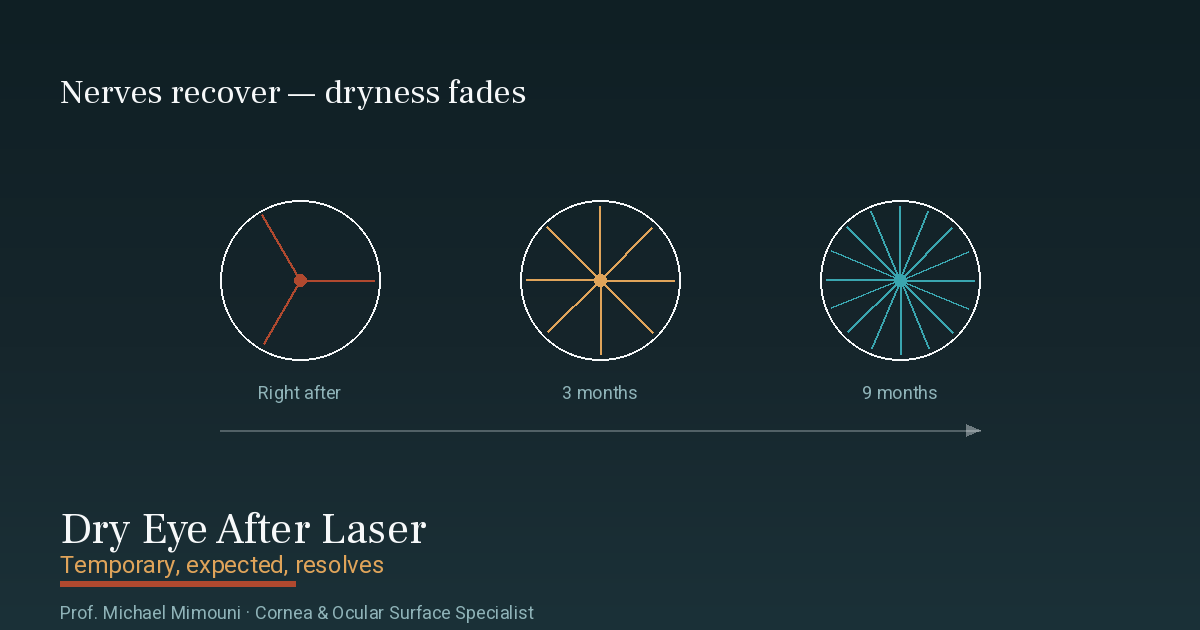
It is important to understand: the nerves recover. The cornea gradually renews its innervation over the months following surgery, and as the nerves return to function, the dryness resolves.
How Long It Lasts
This is the question everyone cares about, and the answer is encouraging: in most patients the dryness is prominent mainly in the first weeks and improves gradually. Within about three months the vast majority feel considerable improvement, and within about six to nine months the innervation and natural production return to their normal level, and the sensation returns to how it was. A small percentage of patients experience dryness that lasts longer, but even then it is almost always well manageable.
Throughout this period, supportive treatment — mainly quality artificial tears — makes the wait comfortable. The dryness is noticeable, but it is managed, and it passes.
Who Is at Higher Risk — and Why the Preliminary Examination Is Critical
And here comes the most important part, and it is exactly where my two hats meet. Some people are at higher risk of significant dryness after surgery — and most importantly, many of them suffer from dryness even before the surgery, sometimes without knowing it. In fact, one of the reasons people turn to laser surgery in the first place is that they can no longer tolerate contact lenses — and often the reason for that is existing, undiagnosed dryness.
Anyone starting laser surgery with meibomian gland dysfunction (MGD) or existing untreated dryness starts from an inferior baseline, and the surgery may worsen the condition. Therefore, in such patients, the right approach is not to forgo the surgery, but to treat the dryness first: stabilise the ocular surface, treat the glands if necessary, and only then operate. A patient who goes into surgery with a healthy ocular surface heals better.
This is why, in the laser suitability examination, I devote particular attention to the ocular surface and the glands, and not only to the vision figures and the corneal thickness. Diagnosing dryness before surgery is one of the things that most affects the recovery experience — and it is precisely where dual expertise in refractive surgery and dry eye makes a difference.
How Dryness Is Treated After Surgery
In most cases the treatment is simple and stepwise:
- Quality preservative-free artificial tears — the basis, throughout the recovery period
- Treatment of the ocular surface as needed, including tears rich in lipid components
- Treatment of the glands if there is underlying MGD — compresses, and in certain cases dedicated treatments
- In cases of persistent dryness, additional solutions such as punctal plugs, which slow the drainage of tears and keep the eye moister
The key is follow-up. I monitor patients’ ocular surface at the post-operative check-ups and adjust the treatment according to progress. The dryness passes — my job is to make sure the period until then is comfortable and safe.
So Should You Fear Laser Surgery Because of the Dryness?
No — but you should choose well. Temporary dryness is an expected and managed price of successful surgery, and it resolves in the vast majority. What really matters is two things: a thorough preliminary examination that includes ocular-surface assessment (and not just vision), and early treatment of existing dryness if it is discovered. A patient who goes through this path enters surgery prepared and comes out of it with a smoother recovery.
When to See a Doctor
If you have had laser surgery and are experiencing dryness, in most cases it is an expected part of recovery. But it is worth seeking an evaluation if:
- The dryness is severe, painful, or interferes with daily functioning
- The symptoms do not improve at all over the first months
- There is a decline or fluctuation in vision that does not stabilise
- Artificial tears do not provide sufficient relief
And if you are considering laser surgery and have a history of dryness, contact-lens intolerance, or dry-eye symptoms — it is worth assessing the ocular surface before making a decision about the surgery.
I perform laser suitability examinations and ocular-surface assessments at my clinic in Haifa and across northern Israel, and I combine both specialities — laser vision correction and dry eye — precisely in order to give a complete answer on this subject. You are welcome to get in touch and schedule an evaluation.
Frequently Asked Questions
Does dry eye after laser vision correction go away? Yes, almost always. The dryness is caused by a temporary effect on the corneal nerves, which gradually recover. In most patients the dryness is prominent in the first weeks, improves significantly within about three months, and resolves almost completely within six to nine months as the innervation returns to function.
What causes dry eye after laser vision correction? The surgery reshapes the cornea, and in the process some of the corneal nerves responsible for the sensation of the eye and for tear production are affected. As a result the eye temporarily produces fewer tears and blinks less, until the nerves recover. In LASIK the effect on the nerves is slightly greater than in PRK.
How long does dryness last after laser vision correction? In most patients the dryness is prominent mainly in the first weeks, improves markedly within about three months, and the innervation and natural production return to their normal level within about six to nine months. A small percentage experience more prolonged dryness, but even then it is almost always well manageable with supportive treatment.
Can I have laser vision correction if I already have dry eye? Usually yes, but not before the existing dryness is treated. A patient who goes into surgery with untreated dry eye or MGD starts from an inferior baseline, and the surgery may worsen the condition. The right approach is to stabilise the ocular surface and treat the glands first, and only then to perform the surgery — recovery is better that way. A preliminary examination of the ocular surface is critical.
How do you prevent severe dryness after laser vision correction? The key is a thorough preliminary examination that includes assessment of the ocular surface and the meibomian glands — not just vision figures and corneal thickness — and treating existing dryness before surgery if it is found. A patient who goes into surgery with a healthy ocular surface experiences a smoother recovery and less dryness. After surgery, follow-up and supportive treatment ensure the recovery period is comfortable.
Frequently asked questions
Does dry eye after laser vision correction go away?
Yes, almost always. The dryness is caused by a temporary effect on the corneal nerves, which gradually recover. In most patients the dryness is prominent in the first weeks, improves significantly within about three months, and resolves almost completely within six to nine months as the innervation returns to function.
What causes dry eye after laser vision correction?
The surgery reshapes the cornea, and in the process some of the corneal nerves responsible for the sensation of the eye and for tear production are affected. As a result the eye temporarily produces fewer tears and blinks less, until the nerves recover. In LASIK the effect on the nerves is slightly greater than in PRK.
How long does dryness last after laser vision correction?
In most patients the dryness is prominent mainly in the first weeks, improves markedly within about three months, and the innervation and natural production return to their normal level within about six to nine months. A small percentage experience more prolonged dryness, but even then it is almost always well manageable with supportive treatment.
Can I have laser vision correction if I already have dry eye?
Usually yes, but not before the existing dryness is treated. A patient who goes into surgery with untreated dry eye or MGD starts from an inferior baseline, and the surgery may worsen the condition. The right approach is to stabilise the ocular surface and treat the glands first, and only then to perform the surgery — recovery is better that way. A preliminary examination of the ocular surface is critical.
How do you prevent severe dryness after laser vision correction?
The key is a thorough preliminary examination that includes assessment of the ocular surface and the meibomian glands — not just vision figures and corneal thickness — and treating existing dryness before surgery if it is found. A patient who goes into surgery with a healthy ocular surface experiences a smoother recovery and less dryness. After surgery, follow-up and supportive treatment ensure the recovery period is comfortable.