If you work at a screen most of the day, you probably know the feeling: by the afternoon your eyes become dry, burning and tired, your vision blurs a little, and you find yourself rubbing them again and again. This is one of the most common complaints I hear in the clinic, and it is only becoming more widespread as we all spend more hours in front of computers, phones and tablets.
The problem has been given a name — “computer vision syndrome” — and there is a great deal of information about it online. The trouble is that much of that information is wrong or superficial, and focuses on the wrong things (such as blue light, which I will expand on below). On this page I will explain what really happens to your eyes at the screen, why it causes dryness, and which of the treatments and pieces of advice actually work and which less so — from a doctor’s point of view rather than a spectacle manufacturer’s.
What Really Happens to the Eye at a Screen
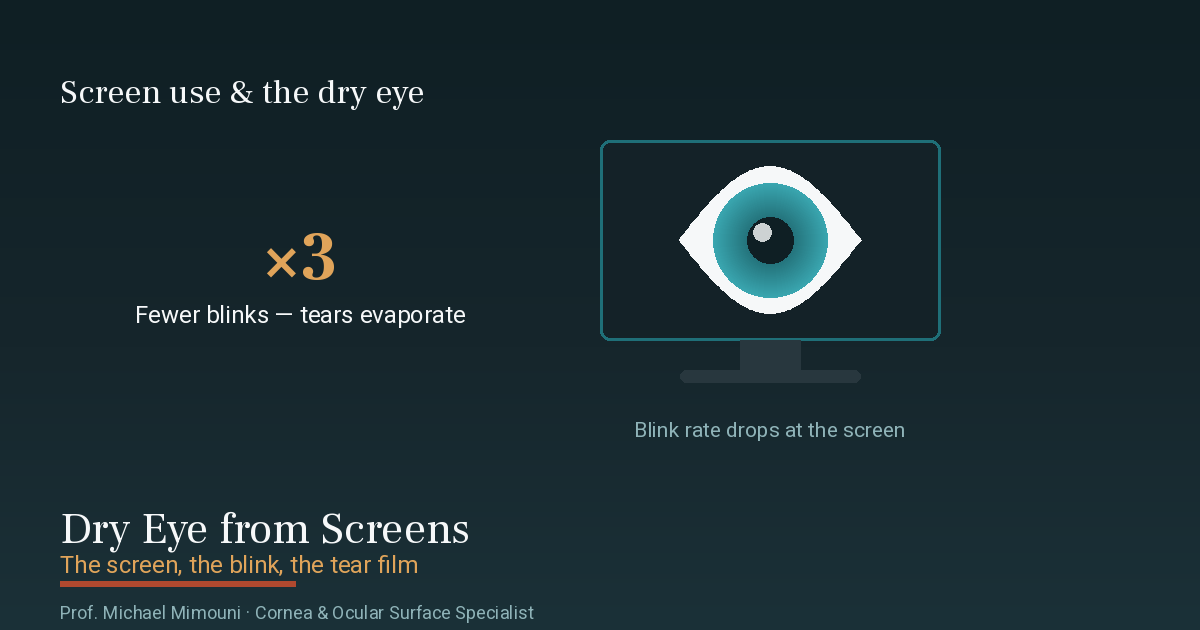
The main reason for dryness at a screen is simple and surprising: we stop blinking. When we concentrate on a screen, our blink rate plummets — studies have measured a reduction of up to three times the natural rate. And this is critical, because blinking is what spreads the tear film over the eye and renews it. Less blinking means a tear film that dries out and is not renewed — hence the sensation of dryness, burning and grittiness.
There is also a second, less familiar factor: when we look at a screen positioned at eye level, we open our eyes wide. When reading a book, by contrast, the gaze is directed downward and the eyelids cover a larger part of the eye. A screen at eye level exposes a larger surface of the eye to evaporation. This is why correct screen positioning — slightly below eye level — genuinely helps.
What About Blue Light? (Separating Fact from Marketing)
Here I want to be precise, because this is one of the areas in which marketing has overtaken the science. The spectacle industry persistently promotes “blue-light filtering glasses” as a solution for dryness and fatigue at the screen. The scientific truth is simpler: there is currently no good evidence that blue light from screens causes dry eye or damages the eye. Dryness is caused by reduced blinking and evaporation — not by blue light.
What is possible? Light from a screen can have an effect on sleep quality if you look at a screen during the night, because it suppresses melatonin secretion. But that is a matter of sleep, not of dry eye. If you have bought blue-light glasses and feel good with them, there is no harm in them. Just do not expect them to solve the dryness, because they do not address the real cause.
What Really Helps — Evidence-Based Advice
Treating dryness at a screen is mainly a matter of changing environmental habits, and most of it is simple to apply:
The 20-20-20 rule. Every 20 minutes, shift your gaze to an object about 6 metres away for 20 seconds. This break forces you to blink and gives your eyes a rest from close focusing. It is the most effective and best-proven piece of advice.
Deliberate blinking. Simply remembering to blink. From time to time, close your eyes completely for a moment — a “full” blink spreads the tear film better than the partial blinks we make at a screen.
Screen position. The screen should be slightly below eye level, so that the gaze is directed slightly downward and the eyelids cover more of the eye. A distance of about 50–70 cm from the eyes.
Environment. An air conditioner blowing directly at your face is very drying — turn it aside. A humidifier helps in a dry room. Avoid direct wind to the eyes.
Artificial tears. During prolonged work, a quality preservative-free drop can provide relief. They are a good symptomatic solution, but do not solve an underlying problem if one exists.
When It Is More Than the Screen — and a Specialist Is Needed
And sometimes — and this is an important point — dryness at the screen is not merely “screen fatigue” but the first sign of a real problem that the screen is only exposing. The most common: meibomian gland dysfunction (MGD), a condition in which the oil glands of the eyelids do not function properly. In someone with MGD, the tear film is already unstable to begin with, and the strain at the screen simply turns the symptoms from tolerable into intolerable.
The practical difference: if the changes to habits and the advice above solve the problem for you — excellent, it was screen fatigue and all is well. But if you have done everything right and still suffer, if the dryness persists even when you are away from the screen, or if artificial tears help only for an hour — it is worth being examined, because there may be an underlying condition requiring real treatment such as dedicated quality tears or IPL treatment.
When to See a Specialist Ophthalmologist
It is worth having an evaluation by a cornea and ocular-surface specialist if:
- Changes to habits and environmental measures have not brought sufficient relief
- The dryness persists at weekends too, and when you are not at a screen
- Artificial tears help only for a short time
- There is persistent redness, a gritty sensation or heaviness of the eyelids
- Your vision blurs intermittently in a way that interferes with work
Untreated chronic dry eye is not merely a discomfort — over time it can damage the ocular surface. Correct diagnosis distinguishes between “screen fatigue” that passes with a change of habits and an underlying condition that requires treatment.
I see patients at my clinic in Haifa and across northern Israel. If you suffer from persistent dryness at the screen that does not resolve with a change of habits, you are welcome to get in touch and schedule an evaluation — we will examine in depth what is causing the dryness and tailor the right treatment.
Frequently Asked Questions
Why do my eyes dry out in front of the computer? The main reason is a sharp drop in the blink rate — when you concentrate on a screen you blink up to three times less than usual. Blinking is what spreads and renews the tear film, so blinking less causes the tears to evaporate without being renewed, and hence the sensation of dryness and burning. Another factor is a screen at eye level, which exposes a larger surface of the eye to evaporation.
Does blue light from screens cause dry eye? No. There is currently no good evidence that blue light from screens causes dry eye or damages the eye. Dry eye is caused by reduced blinking and evaporation, not by blue light. Blue-light filtering glasses are not harmful, but do not expect them to solve dry eye. Light from a screen at night may affect sleep, but that is a separate issue.
What is the 20-20-20 rule? This is the most effective piece of advice for screen-related dry eye: every 20 minutes, look at an object about 6 metres (20 feet) away for 20 seconds. The break forces you to blink and gives your eyes a rest from close focusing, thereby reducing dryness and fatigue.
Do artificial tears solve screen-related dry eye? Quality artificial tears (preservative-free) give good symptomatic relief during screen work, but they do not solve an underlying problem if one exists. If the dryness persists despite using them and despite changing habits, it is worth being examined — there may be an underlying condition such as MGD that requires dedicated treatment.
When does screen-related dry eye require a doctor’s examination? It is worth being examined if changes to habits and environmental measures have not helped, if the dryness persists even when you are away from the screen and at weekends, if artificial tears help only briefly, or if there is persistent redness and recurrent blurring. Sometimes dry eye at the screen is the first sign of an underlying condition such as meibomian gland dysfunction, which the screen merely exposes.
Frequently asked questions
Why do my eyes dry out in front of the computer?
The main reason is a sharp drop in the blink rate — when you concentrate on a screen you blink up to three times less than usual. Blinking is what spreads and renews the tear film, so blinking less causes the tears to evaporate without being renewed, and hence the sensation of dryness and burning. Another factor is a screen at eye level, which exposes a larger surface of the eye to evaporation.
Does blue light from screens cause dry eye?
No. There is currently no good evidence that blue light from screens causes dry eye or damages the eye. Dry eye is caused by reduced blinking and evaporation, not by blue light. Blue-light filtering glasses are not harmful, but do not expect them to solve dry eye. Light from a screen at night may affect sleep, but that is a separate issue.
What is the 20-20-20 rule?
This is the most effective piece of advice for screen-related dry eye: every 20 minutes, look at an object about 6 metres (20 feet) away for 20 seconds. The break forces you to blink and gives your eyes a rest from close focusing, thereby reducing dryness and fatigue.
Do artificial tears solve screen-related dry eye?
Quality artificial tears (preservative-free) give good symptomatic relief during screen work, but they do not solve an underlying problem if one exists. If the dryness persists despite using them and despite changing habits, it is worth being examined — there may be an underlying condition such as MGD that requires dedicated treatment.
When does screen-related dry eye require a doctor's examination?
It is worth being examined if changes to habits and environmental measures have not helped, if the dryness persists even when you are away from the screen and at weekends, if artificial tears help only briefly, or if there is persistent redness and recurrent blurring. Sometimes dry eye at the screen is the first sign of an underlying condition such as meibomian gland dysfunction, which the screen merely exposes.