People come to me after a medical board with exactly the same question: they have suffered from severe dry eye for years, they instill drops six times a day, they cannot work at a screen — and the committee awarded zero percent. How is that possible?
The answer almost always lies in the structure of the impairment schedule itself, not in an arbitrary decision by the board. To know what to expect, you need to understand which item dryness is examined under in the first place, what the schedule requires in order to move from 0% to any percentage at all, and at which point the rating moves to a different table entirely. That is exactly what I will explain here.
The figures on this page are taken from the same impairment schedules on which the site’s eye disability percentage calculator is built — the same items, the same numbers.
There is no item called “dry eye”
The first point, and the most surprising one: the National Insurance impairment schedule has no independent item named “dry eye”. Dryness sits inside Item 55 — “eyelids and conjunctiva”, in sub-item (ד), whose full title is “chronic inflammation of the eyelid or conjunctiva, or dry eye”.
In other words, dryness is weighed together with chronic inflammation of the lid and conjunctiva, as one condition within a family of lid and ocular-surface states. Anyone arriving at the board expecting the diagnosis “Dry Eye Disease” to translate into an item of its own discovers that no such item exists.
Two grades, and what separates them
Within Item 55(ד) there are only two grades:
- Mild or moderate — 0% for one eye, 0% for both eyes.
- Severe, with damage to the cornea or the tarsal conjunctiva — 10% for one eye, 15% for both.
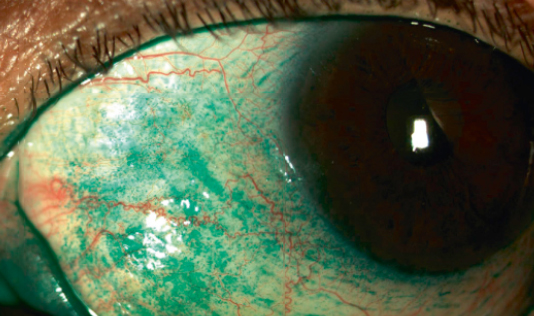
That is the entire range. There is no intermediate grade, and no points are given for the number of drops per day or the degree of distress. The word that decides everything is “damage”. The schedule grades dryness not by symptom intensity but by an objective finding in the eye: documented damage to the cornea or the tarsal conjunctiva — the mucosal lining of the inner surface of the eyelid.
This explains the gap that frustrates patients so deeply. Dryness that causes constant burning, lost working hours and complete dependence on drops, but without a finding observed and documented on examination, is classified by the schedule as “mild or moderate” — that is, 0%. The board is not dismissing the suffering; it is reading an item that was drafted around damage, not around symptoms.
From this follows the practical conclusion: what creates the difference between 0% and 10% is medical documentation over time, and above all documentation of findings — corneal staining, recurrent epithelial breakdown, tarsal conjunctival changes — not descriptions of how severe the complaint feels.
What does not accumulate
Item 55 carries an explicit note worth knowing: percentages are not awarded simultaneously for sub-items (ב), (ג) and (ד) together. This means that dryness (ד), ectropion or entropion (ב) and lagophthalmos (ג) — three eyelid conditions that can certainly coexist in the same person — do not add up with one another in the same eye. The board chooses the appropriate item, not the sum.
For completeness: (ב) and (ג) are graded the same way — 0% in the mild grade, and 10% for one eye or 15% for both in the severe grade.
The items people confuse them with
Three other items come up in almost every conversation about dry eye, and none of them is what it seems:
Item 56 — the tear ducts. This is the drainage item, not the production item. Mild narrowing with insignificant disturbance gives 0%; drainage obstruction with external tearing, proven by an ancillary test, gives 5% for one eye or 10% for both. Many patients describe “tearing” and assume it is the opposite of dryness — in fact reflex tearing is a common symptom of dry eye, and it confers nothing under Item 56 unless an anatomical obstruction is proven.
Item 59 — conjunctivitis and blepharitis. This item was repealed in National Insurance by the 2012 amendment. Old guides and forum posts still cite it, and it is a source of expectations with nothing to stand on. Under National Insurance, lid and conjunctival inflammation no longer confers percentages in its own right.
Item 61 — corneal opacities. An opacity 2 mm or larger in diameter, within the central 4 mm, gives 5% for one eye or 10% for both — but only in the absence of a visual impairment that confers disability. The schedule states explicitly: an opacity causing a visual acuity impairment that confers disability is rated by visual acuity alone, not by this item.
How dry eye does reach meaningful percentages
And this is the most important point on this page. All the numbers above move between 0% and 15%. The only route by which dry eye disease reaches genuinely high percentages is visual acuity.
When severe chronic dryness has caused sustained damage to the corneal surface to the point of a permanent reduction in best-corrected visual acuity, the rating moves to the visual acuity table — the two-dimensional table that cross-references the right eye’s vision against the left’s. There the range is no longer 0–15 but up to 100%.
So if your dryness has reached that stage, the critical measurement for the board is best-corrected visual acuity, documented in a stable state rather than on a random good day. You can see exactly which percentage each combination of vision in the two eyes translates into in the disability percentage calculator.
A technical point worth knowing in this context: when there are several impairments, the percentages are not added by simple addition. They are weighted — each further impairment is taken out of the remaining balance. 10% plus 10% is not 20% but 19%. That is why manually summing items almost always produces a number that is too high.
The Ministry of Defense: a fundamentally different picture
Anyone injured during service and handled by the Ministry of Defense operates under a different schedule — the Disabled Persons regulations — and the difference on dry eye is dramatic.
Item 56 — tear ducts, tear deficiency. Here there is a sub-item (ב) literally titled “tear deficiency”:
- Mild to moderate — 1% for one eye, 2% for both.
- Marked or complete — 10% for one eye, 20% for both.
Two differences stand out immediately. First, the mild-to-moderate grade is not zeroed out: it confers a percentage, and that changes the picture when it is weighted with other impairments. Second, the severe state in both eyes reaches 20%, against 15% under National Insurance. Sub-item (א), drainage disturbances, is graded the same way: 1%/2% without external tearing, 10%/20% with it.
More important still — the note to Item 56 provides that accompanying corneal and conjunctival findings receive additional disability under the appropriate test items. That is an explicit accumulation instruction — precisely the opposite of the non-accumulation rule of Item 55 under National Insurance.
Item 59 — conjunctivitis, blepharitis. The item repealed in National Insurance is alive and well at the Ministry of Defense: mild 1%/2%, moderate 5%/7%, severe 10%/15%.
Item 61 — corneal opacity. Without a cosmetic defect 1%/1%; with a cosmetic defect 5%/10%.
The practical conclusion: exactly the same dry eye, with exactly the same medical file, can be rated 0% on the National Insurance track and receive percentages on the Ministry of Defense track — and there it also accumulates with the corneal and conjunctival items. This is not inconsistency; it is two schedules written at different times for different purposes.
What should be documented before the board
Since the move from 0% to percentages depends on findings rather than complaints, it is worth arriving with a file that shows findings over time:
- repeated ocular-surface examinations with documented staining of the cornea and conjunctiva, not just a verbal summary of complaints
- best-corrected visual acuity measured on more than one date, to show a stable state rather than a one-off fluctuation
- documentation of the treatments tried and the response to them — drops, lid therapy, punctal plugs, advanced treatments
- physician letters that phrase the condition in the schedule’s language: the degree of damage to the cornea and conjunctiva, not only symptom severity
- documents showing continuity — dryness documented once reads differently from dryness documented over two years
If you are still at the treatment stage rather than the board stage, the right place to start is an explanation of dry eye and the conditions that feed it, first among them meibomian gland dysfunction. A real improvement in the condition always beats an improvement in the rating.
Appeal deadlines
If the result does not reflect the condition, there are hard deadlines, and they differ between the tracks.
In general disability, the appeal is filed within 60 days of receiving the written notice of the decision, and only if less than 80% medical disability was set.
In work injury the deadline is far shorter: the appeal, with its reasons, must be submitted in writing within 30 days of receiving the notice of the medical board’s decision, on Form 247. A further appeal against the appeals committee’s decision goes to the regional labor court, in writing, within 60 days of receiving the notice — on questions of law only.
The gap between 30 and 60 days is one of the most common confusions, and it is costly: whoever assumes they have two months on the work-injury track loses the right of appeal.
One more point worth knowing in advance: the appeals committee may also lower the percentage that was set, not only raise it. In certain cases the appeal can be withdrawn after notice of this is given. A proper appeal is therefore a grounded one — resting on a documented finding that the first board did not see or did not weigh, not on a feeling that the result is too low.
Bottom line
Dry eye is one of the widest gaps between the suffering the patient experiences and what the impairment schedule measures. Under National Insurance it has no item of its own, it is rated inside the eyelids-and-conjunctiva item, and it confers percentages only once it has reached a severe grade with documented damage. At the Ministry of Defense it is measured differently and accumulates differently. And on both tracks, the route by which dryness reaches meaningful numbers runs through visual acuity.
Whoever enters the board with this picture in mind knows what is worth bringing — and what will not move the needle.
Frequently asked questions
How many disability percent does dry eye give in Israel?
Under National Insurance (Bituach Leumi), dry eye on its own — even when it is very disruptive day to day — is graded 'mild or moderate' and gives 0%. Percentages are awarded only when the dryness has reached a severe degree with documented damage to the cornea or the tarsal conjunctiva, and then it is 10% for one eye or 15% for both. Under the Ministry of Defense the picture is entirely different: mild-to-moderate tear deficiency gives 1% for one eye or 2% for both, and marked or complete tear deficiency gives 10% for one eye or 20% for both.
Is there even an impairment item called 'dry eye'?
Not an independent one. In the National Insurance impairment schedule, dryness sits inside Item 55, titled 'eyelids and conjunctiva', in sub-item (ד) — 'chronic inflammation of the eyelid or conjunctiva, or dry eye'. Dryness is therefore examined together with chronic lid and conjunctival inflammation, not as a diagnosis of its own. This is one reason people arrive at the board expecting a rating that simply does not exist in the schedule.
What counts as 'severe dry eye' for the medical board?
The schedule is not satisfied by complaints or by symptom intensity. The severe grade is defined by damage — 'damage to the cornea or the tarsal conjunctiva'. In practice that means an objective finding seen on examination and documented: significant corneal staining, recurrent epithelial breakdown, changes of the tarsal conjunctiva. Severe symptoms without a documented finding in the medical record tend to be graded 'mild or moderate' — that is, 0%.
Can I receive percentages for both the dryness and tearing from the eye?
Under National Insurance — not simultaneously for the same eye. Item 55 states explicitly that percentages are not awarded at the same time for sub-items (ב), (ג) and (ד), so dryness, ectropion or entropion, and lagophthalmos do not accumulate in one eye. External tearing due to drainage obstruction is an entirely different item (56), giving 5% for one eye or 10% for both — and only when the obstruction is proven by an ancillary test. Under the Ministry of Defense, by contrast, the note to Item 56 explicitly permits additional disability for accompanying corneal and conjunctival findings.
What if the dryness has reduced my visual acuity?
That is how dry eye reaches meaningful percentages. When the dryness has caused a permanent reduction in best-corrected visual acuity, the rating moves to the visual acuity table and no longer stays in the eyelid item. The schedule even says this explicitly for corneal opacities: an opacity causing a visual impairment that confers disability is rated by visual acuity alone, not by the opacity item. That is why best-corrected acuity should be measured and documented in a stable state, not on a random good day.
How long do I have to appeal a committee decision?
In general disability, the appeal is filed within 60 days of receiving the written notice of the decision, and only if less than 80% medical disability was set. In work injury the deadline is shorter: the appeal, with its reasons, must be submitted in writing within 30 days of receiving the notice, on Form 247. A further appeal against the appeals committee's decision goes to the labor court within 60 days, on questions of law only. The gap between 30 and 60 days is a common source of confusion. It is also important to know that the appeals committee may lower the percentage that was set, not only raise it.