Most people who want to be rid of their glasses think of laser — LASIK, PRK or SMILE. But not everyone is suitable for laser: a prescription too high, a cornea too thin, or a borderline corneal shape take some patients out of the running. For them there is an entirely different route — the phakic lens (ICL), a lens implanted inside the eye that corrects vision without touching the cornea. This page explains what it is, who it suits, and its advantages and risks. For a picture of the laser methods, see laser vision correction.
What a phakic lens is
A phakic lens is a soft, thin lens, made of a tissue-compatible material (collamer), implanted inside the eye through a tiny incision. It sits in front of the natural lens and behind the iris, and corrects the prescription just as glasses or a contact lens would — except that it is inside the eye. The word “phakic” means the eye’s natural lens stays in place: the implanted lens is added to it, not a replacement for it. This is also why the procedure is reversible — the lens can be removed in the future if needed.
Three routes, three levels
To place the ICL correctly, it helps to compare it with the two other routes:
- Laser (LASIK, PRK, SMILE) reshapes the cornea and removes tissue from it. Limited by corneal thickness and the size of the prescription.
- The phakic lens (ICL) does not touch the cornea at all — it adds a lens inside the eye. It treats high prescriptions and thin corneas that laser cannot.
- Lens replacement (as in cataract surgery) removes the natural lens and replaces it. Usually reserved for older age or when the natural lens is no longer clear.
The ICL is therefore the option that extends refractive surgery to those the cornea rules out of laser — without going as far as replacing the natural lens.
The new generation: a tiny central port
In the early generations of the phakic lens, a small opening had to be made in the iris (an iridotomy) to allow the eye’s fluid to flow. The current generation of the ICL includes a tiny central port in the lens itself, through which the fluid flows naturally — so a separate iridotomy is no longer needed, and the risk of developing a cataract or a rise in intraocular pressure is lower than before. This is a significant advance that has made the procedure safer.
The advantages
- The cornea is fully preserved. No tissue is removed, so there is no weakening of the cornea — an advantage especially in high myopia or a borderline cornea.
- A wide treatment range. The ICL corrects high prescriptions, beyond the limit at which laser stops being suitable.
- High visual quality. In high myopia, the ICL tends to produce fewer optical aberrations and better contrast than laser, including in night vision.
- Less dry eye. Unlike laser, there is no cutting of the corneal nerves, so dryness after the procedure is rarer.
- Reversible. If the situation changes — for example a cataract developing with age — the lens can be removed.
The risks and considerations
The ICL is intraocular surgery, so it carries risks that do not exist with laser: the development of a cataract (rarer in the new generation), a rise in intraocular pressure, and gradual loss of endothelial cells — the inner layer that keeps the cornea clear. The size of the lens (the “vault” — the gap from the natural lens) must be precise. Suitability therefore depends on measurements: an adequate anterior chamber depth and a normal endothelial cell count are threshold conditions.
Who is a candidate
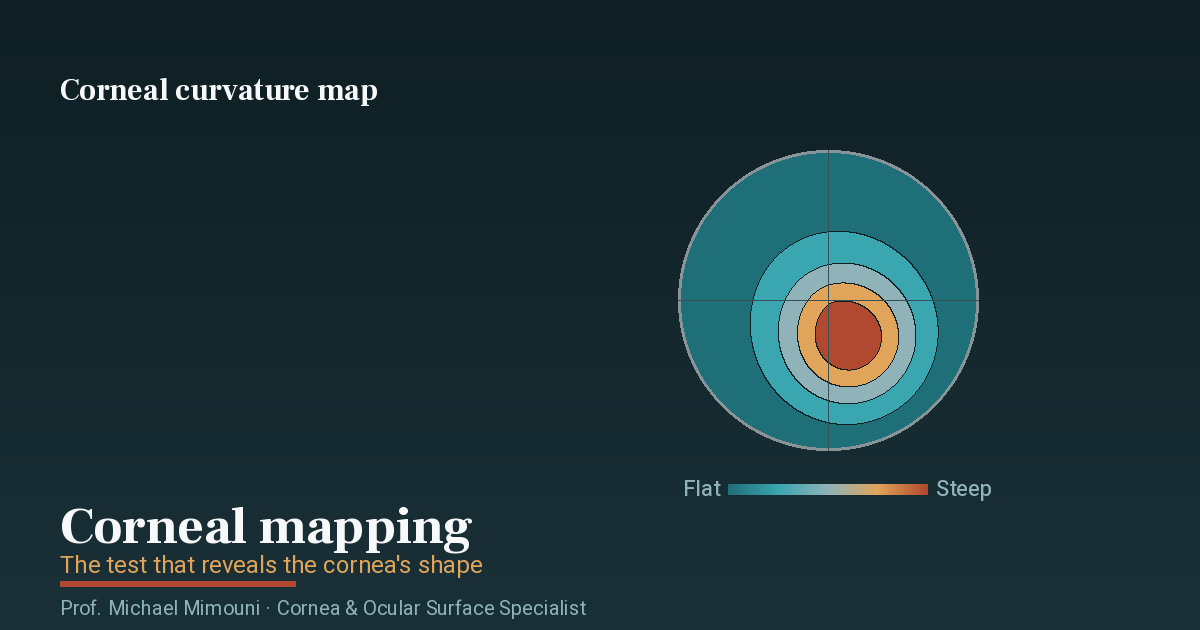
As with any refractive surgery, the decision is based on measurements, not preference: the size of the prescription, the thickness and shape of the cornea, the depth of the anterior chamber and the endothelial cell count. The ICL stands out as an option when laser is unsuitable — high myopia, a thin cornea, or an irregular shape. The final choice between laser, SMILE and a phakic lens is made after a full preliminary examination that includes corneal mapping and measurements of the front of the eye.
Bottom line
The phakic lens (ICL) is the lens-based option for vision correction — a lens added inside the eye without touching the cornea and without removing the natural lens. It solves precisely the cases where laser stops: a prescription too high or a cornea too thin. There is no sweepingly “best method” — there is a right fit for each eye, and the ICL is the tool that extends the possibility to those whose cornea closes the door on laser. The way to know whether it suits is a preliminary examination, not a rule of thumb.
The information on this page is general and not a substitute for a personal examination and medical advice. Suitability for a phakic lens and the choice of correction method are determined at a preliminary examination with an ophthalmologist.
Frequently asked questions
What is a phakic lens (ICL)?
The ICL (Implantable Collamer Lens) is a soft lens implanted inside the eye, positioned in front of the natural lens and behind the iris, that corrects the prescription. The word 'phakic' means the eye's natural lens stays in place — unlike cataract surgery, where the natural lens is replaced. It is an addition, not a replacement, which is why it can also be removed in the future. The cornea is not touched at all.
Who is a candidate for a phakic lens?
It is mainly intended for high myopia — a wide range reaching to around 20 dioptres — and for astigmatism (in a toric version), and especially for those unsuitable for laser: a cornea too thin, an irregular corneal shape, or a suspicion of keratoconus. Suitability is decided by measurements of the eye — the depth of the anterior chamber and the count of endothelial cells in the cornea must be adequate.
What is the difference between a phakic lens and laser?
Laser (LASIK, PRK or SMILE) reshapes the cornea and removes tissue from it, so it is limited by corneal thickness and the size of the prescription. A phakic lens does not touch the cornea at all — it adds a lens inside the eye, so it treats higher prescriptions and thin corneas too. It also offers high visual quality and less dry eye. On the other hand, it is intraocular surgery, so it carries other risks — cataract, a rise in pressure, and gradual loss of endothelial cells.
Is a phakic lens the same as cataract surgery?
No. In cataract surgery the natural lens is removed and replaced with an artificial lens. With a phakic lens the natural lens **stays**, and the implanted lens is added in front of it. This is an important distinction: an ICL suits relatively younger people whose natural lens still functions, whereas a lens replacement suits when the natural lens is already clouded or has lost its focusing ability. On lens choice in cataract surgery, see [cataract lens choice](/en/cataract-lens-choice/).