Laser vision correction is usually known through the two established methods, LASIK and PRK. But over the past decade a third method has come into use — SMILE — whose distinction is that it reshapes the cornea without creating a flap at all. This page explains what SMILE is, how it differs from the other two methods, and who it suits. For the full picture of LASIK and PRK, recovery and success rates, see laser vision correction.
How SMILE works
The name SMILE stands for Small Incision Lenticule Extraction. Instead of exposing the inside of the cornea, a femtosecond laser draws a lenticule within the thickness of the cornea — a thin disc of tissue whose shape is calculated precisely to the patient’s prescription. The surgeon removes the lenticule through a tiny incision at the edge, about 2 mm across. The removed tissue changes the curvature of the cornea exactly as in the other methods — but here it is done from within, without a flap and without removing the epithelial layer.
SMILE, LASIK and PRK — three routes to the same goal
The three methods share one principle — a precise change to the shape of the cornea — but they differ in how they reach the tissue being reshaped:
- LASIK creates a thin flap in the cornea, lifts it, reshapes the tissue beneath with a laser and replaces the flap. Recovery is very fast and almost painless.
- PRK removes the outer epithelial layer, reshapes the surface of the cornea, and lets the epithelium regrow within days. There is no flap, but recovery is slower and accompanied by discomfort.
- SMILE creates no flap and removes no epithelium: it extracts a lenticule from within the cornea through a tiny incision. In a sense it is the middle route — without the flap of LASIK and without the broad surface wound of PRK.
The advantages of SMILE
The absence of a flap is the source of most of the advantages:
- Corneal biomechanical stability. Because the peripheral fibre network of the cornea stays more intact, the cornea remains mechanically stronger. This is especially relevant to occupations or sports with a risk of direct eye trauma.
- Fewer flap-related complications. There is no flap that could shift, wrinkle or be injured by a later blow.
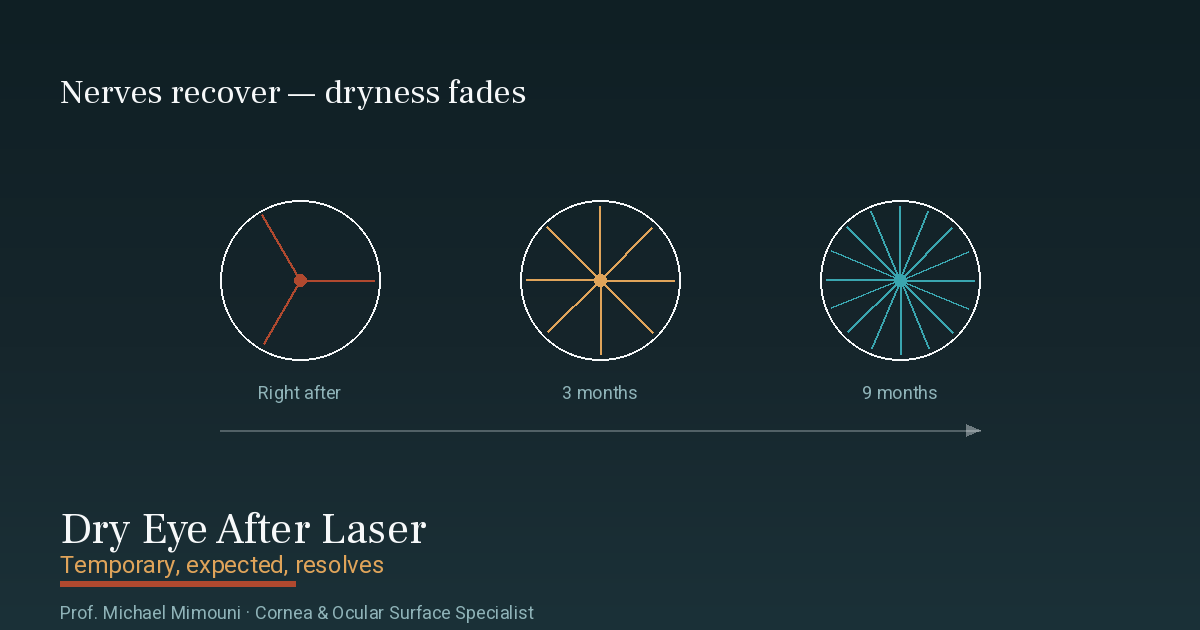
- Less dry eye after surgery. The small incision cuts fewer of the corneal nerves responsible for surface sensation and tear production, so the dryness after SMILE tends to be milder than after LASIK. On this phenomenon in detail, see dry eye after laser surgery.
The limitations worth knowing
- The treatment range. SMILE is approved for myopia and myopic astigmatism, but is not currently intended for farsightedness (hyperopia), which remains in the research domain.
- Slightly slower visual recovery. In the first days, vision after SMILE usually sharpens a little more slowly than after LASIK, even if the final result is similar.
- A different top-up. If further adjustment is needed, a flap cannot be lifted as in LASIK; it is usually done by a surface method (PRK).
Who is a candidate
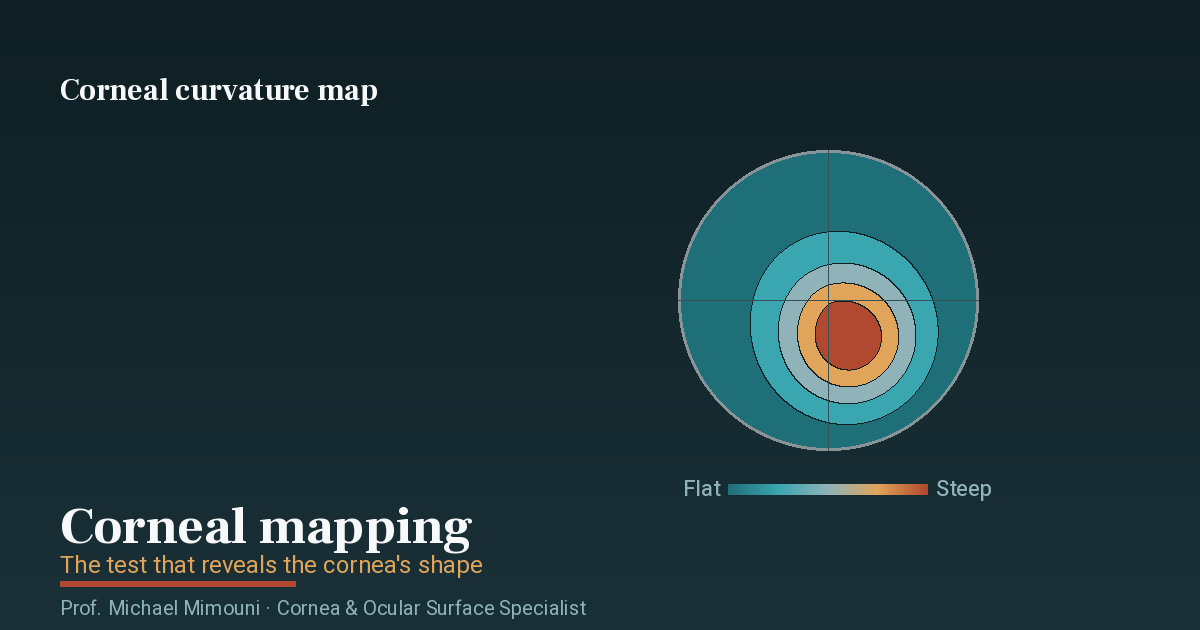
As with all laser methods, the cornea decides, not the preference. Adequate corneal thickness, a regular shape on mapping, and a stable prescription over time are required. Within that framework, SMILE particularly appeals to those who want to avoid a flap: patients prone to dry eye, contact-sport athletes, and those whose work exposes them to eye trauma. The final choice between SMILE, LASIK and PRK is made after corneal mapping and a full preliminary examination, weighing the structure of the cornea, the size of the prescription and lifestyle.
On what determines the cost of each method, see the cost of laser eye surgery.
Bottom line
SMILE is the third method of laser vision correction, and the only one that works without a flap — an advantage that shows up in better corneal biomechanical stability and less dry eye, at the price of slightly slower recovery and a treatment range limited to myopia and astigmatism. It is not sweepingly “better” or “worse” than LASIK and PRK — it is an additional tool, and each patient has the method that suits their cornea. The way to know which is a preliminary examination, not a rule of thumb.
The information on this page is general and not a substitute for a personal examination and medical advice. Suitability for laser surgery, and the choice of method, are determined at a preliminary examination with an ophthalmologist.
Frequently asked questions
What is SMILE surgery?
SMILE (Small Incision Lenticule Extraction) is a method of laser vision correction in which a femtosecond laser shapes a thin disc of tissue (a lenticule) within the thickness of the cornea, and the surgeon removes it through a tiny incision of about 2 mm. The cornea is reshaped from within, without creating a flap and without removing the epithelial layer. It is the third and relatively new method, alongside LASIK and PRK.
What is the difference between SMILE and LASIK?
The central difference is the flap. In LASIK a thin flap is created in the cornea, lifted, the tissue beneath is reshaped, and the flap is replaced. In SMILE there is no flap at all — a lenticule is removed through a small incision. Because the cornea stays more intact, SMILE has an advantage in corneal biomechanical stability, fewer flap-related complications, and usually less dry eye after surgery, since fewer of the corneal surface nerves are cut. On the other hand, visual recovery in SMILE is usually a little slower than in LASIK.
Who is a candidate for SMILE?
SMILE is currently approved for correcting nearsightedness (myopia) and myopic astigmatism, but not farsightedness (hyperopia). As with all laser methods, suitability is decided by the cornea: adequate thickness, a regular shape and a stable prescription over time. It is sometimes preferred by those who want to avoid a flap — people prone to dry eye, contact-sport athletes or occupations with a risk of eye trauma. But the choice between the methods is always made by the corneal mapping, not by preference alone.
If the prescription returns after SMILE, can it be corrected?
Yes, but differently. In LASIK the flap can be lifted again for a touch-up; in SMILE there is no flap to lift, so a top-up is usually done by a surface method (PRK). This is a consideration worth knowing in advance, though the need for a top-up is not common when the prescription is stable and the patient is well selected.