Around the age of 40 to 45, the same familiar story begins: the text on your phone shrinks, the restaurant menu blurs, and you find yourself holding things farther away to read. This is presbyopia — the natural weakening of near vision with age — and it reaches everyone, even those who have seen perfectly all their lives. It is not a disease and not a sign that something is wrong with the eye; it is the natural lens gradually losing its flexibility. This page explains what happens, what the real options for correcting it are — from the simplest to the surgical — and how to choose between them.
What presbyopia is, and why it happens to everyone
Inside the eye is a natural lens, clear and flexible, that changes shape to focus light from near and far. In youth it is flexible and shifts focus easily; over the years it stiffens and loses the ability to “bend” for near focus — so, around age 40–45, reading blurs. This is entirely separate from myopia, hyperopia or astigmatism: someone with excellent distance vision develops presbyopia just like anyone else. It is also why someone who had successful laser vision correction may still need reading glasses later — the laser reshaped the cornea, but it does not stop the lens from ageing.
The simple option: glasses and contact lenses
The most common, safest and cheapest route is an optical aid: reading glasses, progressive (multifocal) glasses that give distance and near in one pair, or contact lenses — including multifocal ones. There is nothing “lesser” about this; for many people it is the right answer. Surgery enters the picture when dependence on glasses interferes with daily life, or when someone genuinely wants to be free of them.
Monovision — one eye for distance, one for near
A long-established solution: one eye (usually the dominant one) is set for distance and the other for near, and the brain learns to combine them. This can be achieved with a laser or with lens replacement. The advantage is independence from glasses in many situations; the drawback is that not everyone adapts to the difference between the eyes, and depth perception can be slightly affected. So tolerance for monovision is almost always tested first with contact lenses before anything permanent is done.
Laser correction
In some patients the cornea can be shaped with a laser to create more than one focal depth (PresbyLASIK), or laser monovision can be used. These methods suit mainly the earlier stage of presbyopia, when the natural lens is still clear, and their suitability depends on the shape of the cornea and the prescription. The full picture of laser correction — advantages, limits and the preliminary examination — is on laser vision correction.
Lens replacement — the option that treats the root
As age advances, and especially once the natural lens is already beginning to cloud or stiffen, the option that treats the root of the problem is replacing the natural lens with an advanced intraocular lens. Technically this is exactly cataract surgery — the natural lens is removed and an artificial lens is implanted in its place — except that here it is done electively, to correct vision, and sometimes even before a true cataract has developed. The major advantage: an advanced lens (multifocal, trifocal or EDOF) can provide both distance and near vision, and because the natural lens has been removed, a cataract will not develop in the future. Choosing between lens types is a decision in itself, covered in choosing a lens for cataract surgery, and the operation and recovery are described in cataract surgery. A younger patient with a high prescription and a cornea unsuited to laser is sometimes suited to a phakic lens (ICL) — but that does not correct presbyopia on its own.
And drops?
In recent years, drops (based on pilocarpine) have appeared that constrict the pupil and temporarily improve near vision. They may help some people for a few hours, but the effect is partial and temporary, and there are possible side effects. This is a comfort adjunct, not a replacement for glasses or surgery.
How to choose
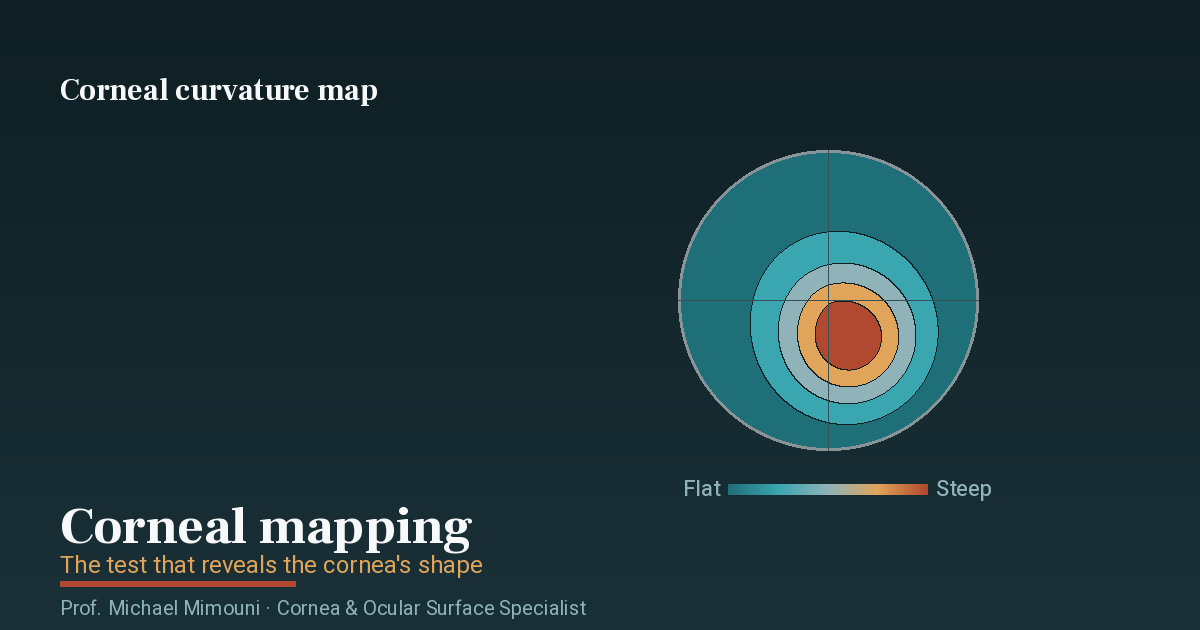
There is no single right answer — the choice depends on age and the state of the natural lens (clear, or starting to cloud), the existing distance prescription, the structure of the cornea, lifestyle and expectations, and whether you get along with monovision. A 42-year-old with healthy eyes will get a different recommendation from a 58-year-old whose lens is beginning to cloud. So the first step is an examination: corneal topography, measuring the prescription, assessing the state of the natural lens, and a conversation about what matters to you.
Examination and consultation
Prof. Michael Mimouni is a specialist in the cornea and in vision correction, and the examination checks which options are relevant for you and the realistic chances of each. If reading glasses have become a nuisance and you want to understand what can really be done, you are welcome to get in touch and arrange an examination at the clinic in Haifa.
The information on this page is general and not a substitute for a personal examination and medical advice. Suitability for each option is determined only after a full examination of the eye.
Frequently asked questions
From what age does presbyopia begin?
Usually around 40 to 45, when near vision starts to blur and your arm 'gets shorter.' It is a natural process that happens to everyone as the natural lens ages, regardless of whether you were previously short- or long-sighted.
Can presbyopia be corrected with a laser?
In some cases yes — through a multifocal shaping of the cornea (PresbyLASIK) or laser monovision — mainly at an earlier stage and while the natural lens is still clear. At an older age, or once the lens begins to cloud, the more effective solution is usually lens replacement with an advanced lens. Suitability is determined by examination.
I had laser surgery in the past — why do I need reading glasses again?
Because the laser corrected the shape of the cornea, but it does not stop the natural lens from ageing. Presbyopia develops in the lens, so it arrives with age even after successful laser surgery. This is not the surgery regressing but a separate process.
Is lens replacement for presbyopia the same as cataract surgery?
Technically it is the same operation — the natural lens is removed and an artificial lens implanted — except here it is done electively to correct vision, sometimes before a cataract has developed. An added benefit: once the natural lens has been replaced, a cataract will not develop in the future.