The cornea is the clear window at the front of the eye, and it provides most of the eye’s focusing power. When it becomes cloudy, distorted, dry, inflamed or damaged – vision suffers, and often eye comfort does too. Most eye problems are well managed by a general ophthalmologist. But there are situations in which it makes sense to see an ophthalmologist who has specialized specifically in the cornea – a cornea specialist. This page explains when, and what happens at the examination.
What does a cornea specialist do
A cornea specialist is an ophthalmologist who, after general residency training, has completed dedicated subspecialty training in diseases of the cornea and ocular surface. The field includes diagnosis and medical treatment of complex diseases, procedures such as cross-linking and therapeutic laser, full-thickness and partial corneal transplants, cataract surgery in eyes with corneal disease, and evaluation before surgery to get rid of glasses.
When to see a cornea specialist
Keratoconus and changes in corneal shape. Early diagnosis, monitoring for progression, and deciding on cross-linking to halt the disease – and later, fitting special lenses or surgery.
Diseases of the corneal layers. Fuchs dystrophy and other endothelial diseases, inherited dystrophies, and corneal swelling (edema) – sometimes after cataract surgery.
Corneal transplant. Determining whether and when a corneal transplant is needed, which type of transplant is suitable – full-thickness or partial (such as DMEK) – and long-term follow-up after the transplant.
Corneal infections and inflammation. Contact lens keratitis, herpes of the eye with recurrent attacks, and infections that do not respond to initial treatment.
The ocular surface. Severe or treatment-resistant dry eye, recurrent corneal erosion, and pterygium growing toward the center of the cornea.
Before surgery. Evaluating the cornea before laser surgery to get rid of glasses, and before cataract surgery when there is underlying corneal disease, in order to choose the right surgery and lens.
When something doesn’t add up. Blurred vision that is unexplained and not corrected by glasses, recurring pain or sensitivity to light, or a corneal scar after an injury or infection.
What happens at the examination
An examination with a cornea specialist starts like any eye examination: a conversation about your complaints and history, a check of visual acuity and glasses prescription, and a slit-lamp examination. Specialized tests are added as needed:
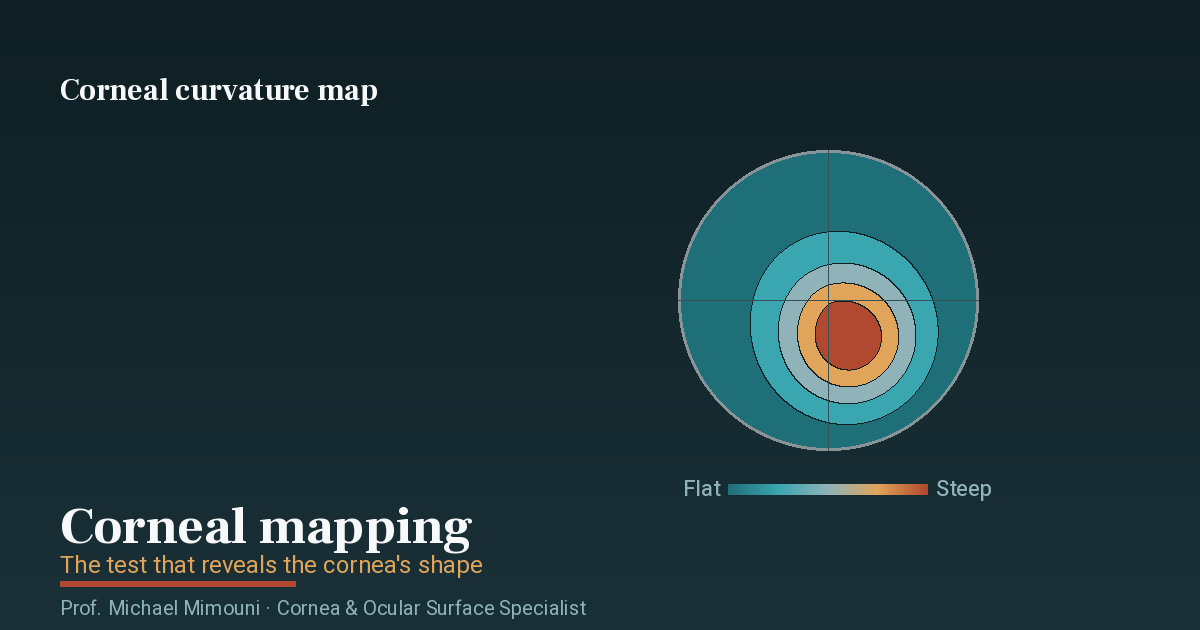
- Corneal mapping (topography or tomography) – a map of the shape and thickness of the cornea, essential in keratoconus and before laser surgery.
- Corneal thickness measurement – important in keratoconus, in corneal swelling and before surgery.
- Endothelial cell count – checks the “pump” that keeps the cornea clear; important in Fuchs dystrophy and before cataract surgery.
- Anterior segment OCT – a cross-sectional image of the corneal layers.
- Tear film and meibomian gland tests – in the diagnosis of dry eye and blepharitis.
Most of the tests are painless, do not require touching the eye or require only an anesthetic drop, and take minutes.
How to prepare for your visit
- Bring summaries of previous visits, earlier corneal maps and surgical reports, if you have them.
- Contact lens wearers: ask in advance how long before the examination you need to stop wearing them – lenses change the shape of the cornea and can make the mapping misleading, especially rigid lenses.
- Bring a list of your current drops and medications.
- It is a good idea to come with someone if your pupils may be dilated.
An examination with Prof. Michael Mimouni
Prof. Michael Mimouni is Director of the Cornea Unit at Rambam, and also sees patients at his clinics in Herzliya Pituach and Haifa for the cornea, cataract, dry eye and laser vision correction. At the examination we will understand what lies behind your complaints, perform the relevant tests, and together build a treatment and follow-up plan. Contact us to schedule an examination. For other eye conditions, see Eye Diseases.
The information on this page is general and is not a substitute for an examination and personal medical advice. Diagnosis and treatment decisions are made only after a complete eye examination.
Frequently asked questions
What is the difference between an ophthalmologist and a cornea specialist?
Every cornea specialist is an ophthalmologist, but after general residency training they have completed dedicated subspecialty training (a fellowship) in diseases of the cornea and ocular surface, corneal transplants and surgery of the front part of the eye. A general ophthalmologist diagnoses and treats most problems, and refers to a cornea specialist when the condition is complex, recurrent or requires specialized surgery.
Do I need a referral to see a cornea specialist?
Through your health fund, a referral from your treating ophthalmologist to a cornea clinic is usually required. For a private visit, you can book an appointment directly. In either case, it is a good idea to bring summaries of previous visits and tests.
Which tests are done at a cornea specialist?
In addition to a vision test and a slit-lamp examination, as needed: corneal mapping (topography/tomography), corneal thickness measurement, endothelial cell count, anterior segment OCT, and tests of the tear film and meibomian glands. Most tests are painless and take minutes.
I'm about to have laser surgery to get rid of my glasses. Do I need a cornea specialist?
The evaluation before laser surgery focuses on the cornea: its thickness, shape and stability. That is exactly why it is important for the corneal map to be reviewed by an expert eye – to detect conditions such as keratoconus early, in which standard laser surgery is not suitable.